
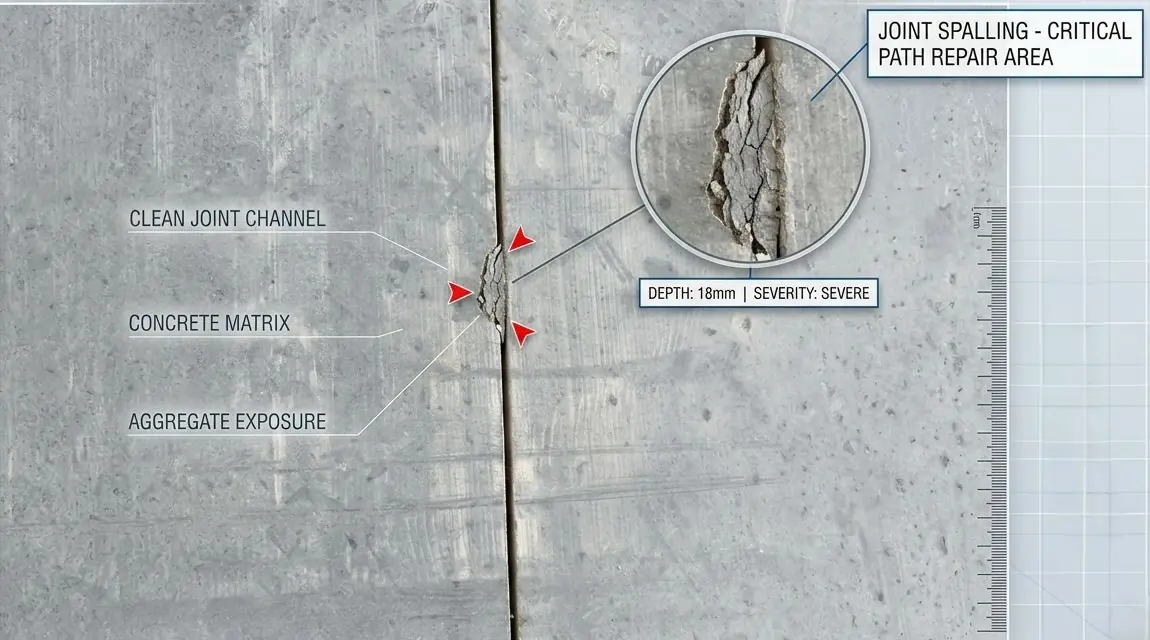
In automated warehouses, the floor joint is the hardest-working detail on the project and the least examined at design stage. When spalling appears along sawn or formed joints within months of go-live, the investigation often leads back to a mix design review that signed off compressive strength, slump and fibre dosage — and said little or nothing about the joint edge.
The strength fallacy
Compressive strength is the headline figure on every delivery ticket, and it's the number a conventional mix review optimises. But spalling isn't a compressive failure. It's a local fracture of the joint edge under impact, dynamic wheel load and stress concentration — a mechanism a 28-day cube result simply doesn't describe.
- Cube strength measures bulk capacity, not edge durability.
- Spalling starts at the arris, where edge support, finishing quality and load transfer all meet.
- A higher strength class will not stop spalling if the joint is poorly supported or detailed.
What automation changes
Driver-operated traffic spreads the load: varied paths distribute joint crossings across the floor. Automated vehicles and shuttles are the opposite. Hard polyurethane wheels, fixed routes and constant cycling turn a handful of joints into permanent stress points.
- Small, hard wheels concentrate contact stress into a tiny area.
- Fixed routes mean the same joints are crossed again and again, every shift.
- Any step or gap at the joint is hit at speed, every cycle.
You can't specify your way out of a spalling problem with a higher strength class. You detail your way out of it.
Why the mix review can't see it
A mix design review is a materials document. Joint spalling is a detailing and execution problem. What decides whether an arris survives — load transfer across the joint, whether the arris is armoured, when the saw cut was made, and how the joint layout relates to the racking and traffic routes — sits largely outside a materials review. And the one mix property that does bear on it, drying shrinkage, is rarely checked against the joint design, even though, with joint spacing, it governs how far joints open. As TR34 puts it, the wider a joint opens and the smaller the wheels, the greater the risk of damage.
Designing spalling out
A specification review looks at the joint as a system, not a line item. Before the first pour, that means resolving how the slab design, the joint detail and the floor's real operational duty fit together.
- Specify engineered load transfer — dowels or proprietary plates — for the dynamic wheel load.
- Armour free-movement joints that small hard wheels will cross, as TR34 advises, and protect sawn joints with a hard, arris-supporting sealant.
- Align the joint layout with the racking grid and vehicle routes, so vehicles cross as few joints as possible.
- Control saw-cut timing — too early can ravel the arris, too late risks random cracking — and cure the slab properly.
Further reading
- The Concrete Society, TR34 Concrete Industrial Ground Floors, 4th edition (2013, reprinted with amendments 2016)
- ACI 360R-10 — Guide to Design of Slabs-on-Ground
- ACI 302.1R-15 — Guide to Concrete Floor and Slab Construction