
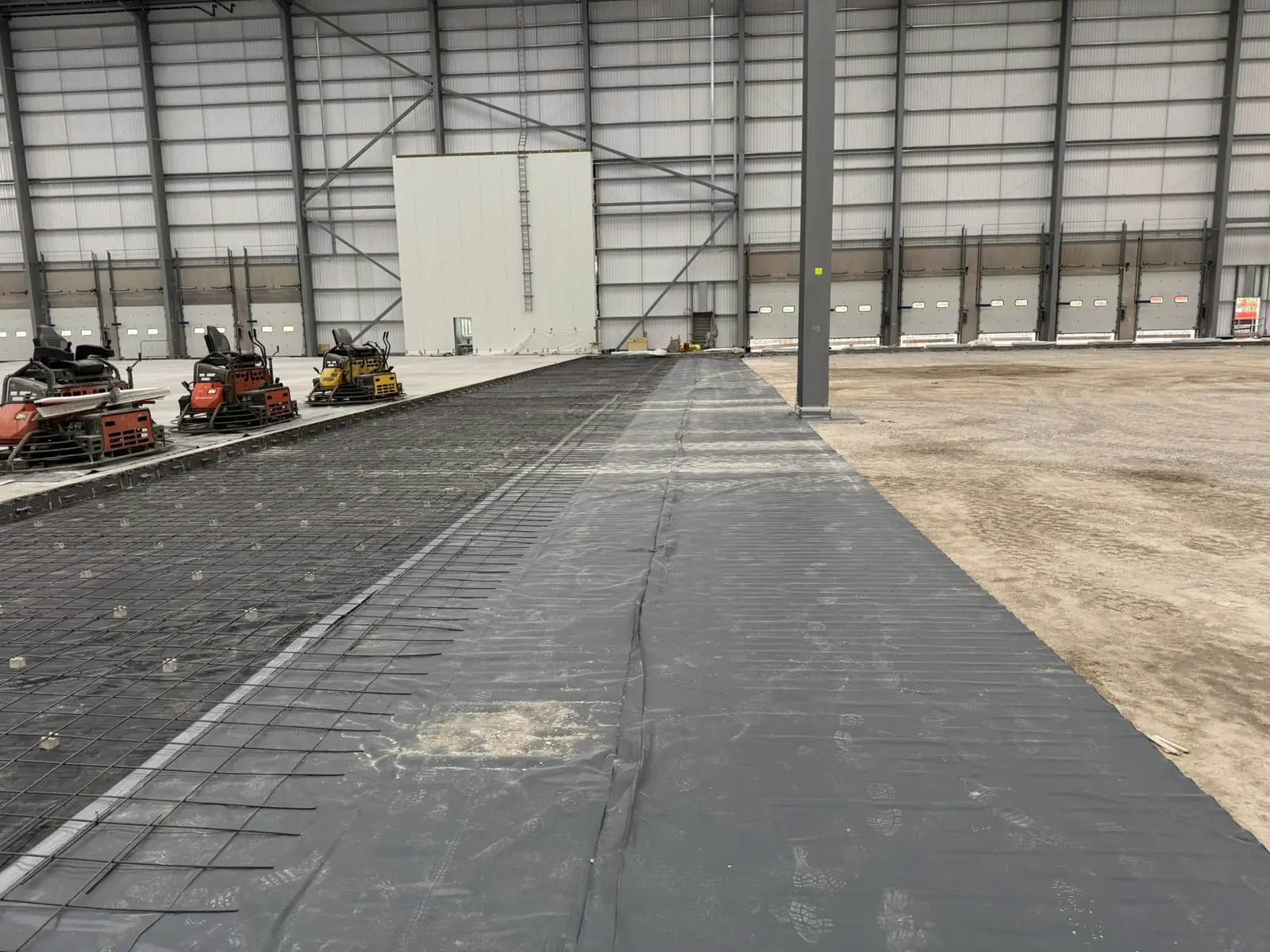
Most industrial floor defects aren't exotic. They're a small set of recurring failures that appear, project after project, when design assumptions and site execution drift apart. The good news for any developer or contractor is that the same short list of decisions prevents most of them.
Curling
Curling is the lifting of slab edges and corners as the top surface dries and shrinks faster than the base. It concentrates load on the joints and leaves edges unsupported, speeding up spalling and cracking. It's controlled by keeping mixing water as low as practical, sensible joint spacing, prompt curing and an honest assessment of the drying environment.
Surface dusting
A dusting surface sheds fine powder under traffic — the sign of a weak, poorly finished or over-watered top layer. It's a workmanship and curing failure, and it's preventable with mix discipline and proper curing.
- Control water added on site — late water raises the water–cement ratio, and the surface suffers first and worst.
- Cure promptly and continuously to develop strength near the surface.
- Avoid finishing operations that bring excess fines and water to the top.
Cracking and joint breakdown
Restraint, poorly timed saw-cutting and inadequate load transfer are common causes of early cracking and joint deterioration. Joints are a floor's planned weak points: spaced, cut and detailed correctly they protect the slab; done badly, they're the first thing to fail.
A floor rarely fails for one dramatic reason. It fails because three ordinary controls were each let slip a little.
The prevention checklist
- Match the specification to the floor's real operational duty, not a generic benchmark.
- Design joints — spacing, load transfer, cutting time — as one system.
- Control water, finishing and curing as the three workmanship fundamentals.
- Build independent hold points into the programme so issues are caught at the pour.
Further reading
- The Concrete Society, TR34 Concrete Industrial Ground Floors, 4th edition (2013, reprinted with amendments 2016)
- ACI 302.1R-15 — Guide to Concrete Floor and Slab Construction
- NRMCA, Concrete in Practice CIP 1 (Dusting) and CIP 19 (Curling)